
Businesses that fail to comply with noise regulations can face fines, compensation claims or enforcement notices as the government’s drive to reduce noise pollution continues.
The legal limits for exposure to workplace noise in the UK are monitored by the Health and Safety Executive, which can even halt operations as a result of breaches in the worst case scenarios.
Noise pollution is taken very seriously, because it affects worker health and safety, and consequently productivity. Prolonged exposure to high noise levels can lead to hearing loss, stress, reduced concentration and increased workplace accidents.
Meeting regulatory standards with acoustic enclosures can ensure compliance with the Control of Noise at Work Regulations 2005. This is crucial to avoid not only penalties, but also a loss of reputation.
What is the legal noise limit at work?
The noise regulations were drawn up to protect hearing, reducing the risks of tinnitus or a loss of hearing over time. The 2005 legislation replaced the Noise at Work Regulations 1989 to set the legal limits.
When workers are exposed to noise levels of 80 dB(A), employers must assess the health risks and give them training and information. The company must provide hearing protection if employees are exposed to noise levels of 85 dB(A) – either daily, or their weekly average exposure. Workers must not be exposed to noise higher than the upper limit of 87 dB(A), taking into account the reduction in exposure as a result of hearing protection.
How to do a noise risk assessment
The aim of a risk assessment is to help businesses decide how to keep workers who are exposed to noise safe and well. As well as measuring the noise, the assessment must identify where the risks occur and who is most likely to be impacted. Then, the employer must identify what’s needed to comply with the law, including the type of noise control measures and hearing protection.
They must also identify which workers need ongoing health surveillance and who is particularly at risk. The estimates should be based on reliable information sources, such as taking measurements in your workplace, comparing them with information from other similar businesses and using data from the machinery suppliers.
Construction site noise
Workers on construction sites are considered to be at a high risk of suffering noise related health issues. Many construction processes tend to be extremely noisy; the general rule is that if employees have to raise their voice to have a conversation with a colleague two metres away, they may be at risk of damaging their hearing.
HSE guidelines state a risk assessment at a construction site can often be carried out without using specific equipment to measure noise levels, as long as it’s based on reliable information and a realistic estimate of the level of exposure. Employers can observe activities, measure how long the employees are exposed to noise over part of their day and use it as the basis to estimate exposure during the total shift.
When employees are exposed to noise from more than one work process or tool, information must be collected on the estimated exposure time and noise level for each separate source. Manufacturers’ information about their tools and equipment is commonly classed as a reliable source to calculate daily noise exposure.
Research suggests up to 40% of the UK’s 2.2 million construction workers may suffer some level of hearing issues. This equates to around 880,000 people, including 23% who have a degree of hearing loss, 25% with a significant hearing impairment and 7% with tinnitus. Around half the employees who have hearing loss report working without any PPE hearing protection for at least some of the time.
Consequences of non-compliance
Non-compliance with noise regulations can result in serious consequences for your business. The most common penalty is a fine, with recent cases having resulted in companies being fined between £50,000 and £145,000 for failing to adequately protect their workforce from excessive noise after the HSE took action. These are the average fines, although they can be higher than this.
The HSO can take various types of enforcement action, including written and verbal advice. They can issue the business with an improvement or prohibition notice, depending on the severity of the breach. In severe cases, the prosecution of a company director can even lead to their imprisonment and disqualification as a director. This could effectively close a business.
Aside from the legal penalties, a company’s reputation can be ruined beyond the fines. When a case of non-compliance is reported in news reports, this can deter customers from trading with the business. It can also ruin existing employee morale, leading to a lack of engagement and a drop in productivity. You could also find yourself struggling with recruitment issues, as new employees won’t be encouraged to work for a company that breaches health and safety laws.
Using acoustic enclosures
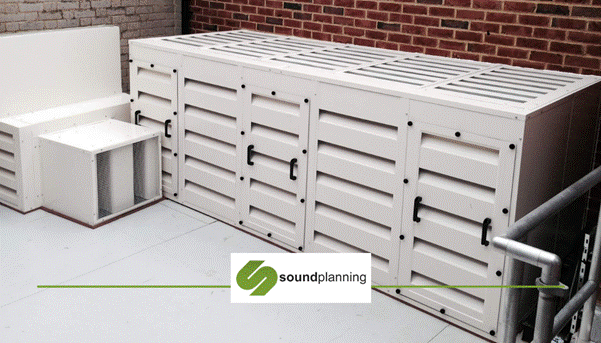
Installing an acoustic enclosure can help to reduce workplace noise, ensuring a quieter environment that protects employees’ health and prevents legal action against your business. Made from materials such as galvanised steel and acoustic wool to ensure durability, they reduce noise levels and prevent reverberation by absorbing and blocking sound waves.
Acoustic enclosures are suitable for indoor and outdoor applications, minimising noise in both environments by using soundproofing science, based on the principles of absorption and transmission.
Features of the acoustic panels and doors supplied by Sound Planning enable easy servicing and airflow accessibility, with custom designs available such as louvered service doors, powder painting, air attenuators, absorptive panels, access doors, timber cladding and weather cowls. You can specify the materials and dimensions required to meet your needs, while retaining aesthetic appeal and functionality.
Acoustic enclosures can also contribute to environmental and sustainability goals by reducing noise pollution and enabling more sustainable industrial practices, including a longer lifespan for equipment and fewer relocations. Whether you’re ensuring compliance with noise regulations, safeguarding sensitive equipment, or simply creating a peaceful workspace, our acoustic enclosures can provide effective soundproofing solutions without compromise.
Please contact us for further information on our products and services.